Blue Energy Motors launches heavy-duty electric truck, unveils Mumbai–Pune ‘electric corridor’
In summary, BEM’s launch signals a key moment in India’s heavy-duty transport electrification journey: a domestic manufacturer, an infrastructure-linked corridor, and a business model aimed at cost-effectively enabling EV adoption. If the Mumbai–Pune electric freight corridor succeeds and scales, it could become a blueprint for other major logistics routes across India.
10/18/20252 min read
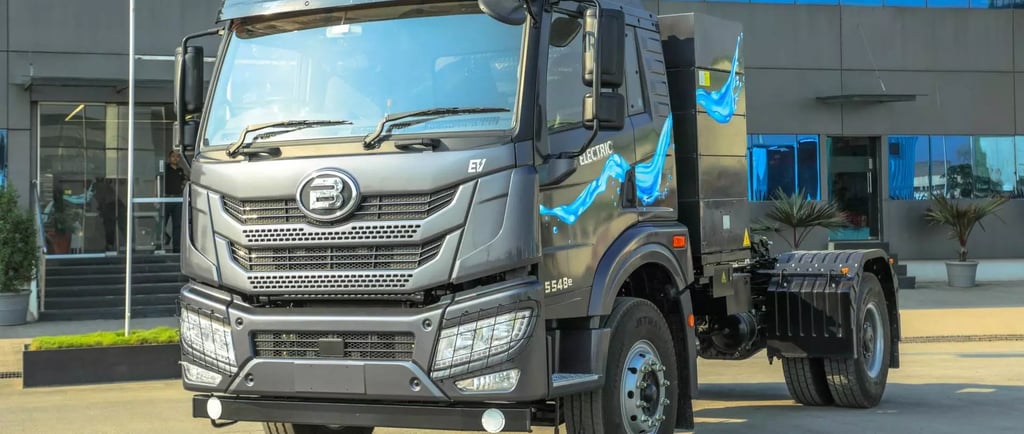
On 16 October 2025, Blue Energy Motors (BEM), a domestic green-truck manufacturer, officially unveiled its new heavy-duty electric truck equipped with battery-swapping technology, and announced the launch of a dedicated Mumbai–Pune “electric corridor” to support its deployment. Indian Transport & Logistics
The event, held at BEM’s 10,000-capacity Chakan facility in Pune, was attended by Maharashtra Chief Minister Devendra Fadnavis, who described the launch as “the Tesla moment for cargo mobility.” Indian Transport & Logistics The corridor will include battery-swapping stations at key locations (JNPA and Pune) to enable faster turnaround for heavy-duty EV trucks on this busy freight route. Indian Transport & Logistics
One of the major barriers to electric heavy-commercial vehicle adoption is the high upfront capital cost, range anxiety, and downtime for charging. BEM’s strategy to tackle this includes an Energy-as-a-Service (EaaS) subscription model, under which customers avoid owning batteries or charging infrastructure and instead pay on a cost-per-kilometre basis. “Under this model, customers don’t need to invest in charging or worry about electricity or battery ownership. Everything is bundled into a simple cost-per-kilometre model.” said Anirudh Bhuwalka, Founder & MD of BEM. Indian Transport & Logistics
Bhuwalka pointed out that the Indian trucking sector contributes nearly 44 % of transport-related CO₂ emissions — with around 4 million trucks in operation, potentially doubling in the next decade. Indian Transport & Logistics At present they emit roughly 450 million tonnes of CO₂; if left unchecked, that could rise to ~900 million tonnes. This, he noted, demands urgent action and innovation. Indian Transport & Logistics
BEM claims its new EV truck offers class-leading performance: high payload capacity, battery energy density, a range of 150-200 km between swaps, and support for ultra-fast battery swapping. Indian Transport & Logistics The swapping stations are designed to be plug-and-play and installable in about 48 hours, requiring just 56 square metres of space. Indian Transport & Logistics
The Mumbai-Pune corridor is strategically significant: the freight flow between these hubs is dense, and enabling electric heavy-duty trucks here could act as a catalyst for wider adoption. Fadnavis emphasised that cargo-handling trucks are among the largest polluters and that India needed domestically-manufactured electric cargo vehicles rather than relying solely on alternative fuels like LNG. Indian Transport & Logistics
BEM reported strong demand, having signed memoranda of understanding (MoUs) for over 10,000 electric trucks, and having an MoU with the Maharashtra government to build a facility with capacity for 30,000 trucks backed by ₹3,500 crore of investment. Indian Transport & Logistics According to the company, since launching its LNG trucks in 2022, it has sold over 1,000 vehicles, clocked 70 million km of operations, and avoided over 20,000 tonnes of CO₂ to date. Indian Transport & Logistics
However, Bhuwalka also emphasised that achieving diesel parity is essential. Electric trucks currently cost nearly three times as much as diesel equivalents. Even with dropping battery prices (he noted a nearly 50 % reduction earlier this year), challenges remain: range limitations, charging time, infrastructure real-estate and high upfront costs. Indian Transport & Logistics By addressing these with battery swapping and the subscription model, BEM believes it has “cracked the code.”
In summary, BEM’s launch signals a key moment in India’s heavy-duty transport electrification journey: a domestic manufacturer, an infrastructure-linked corridor, and a business model aimed at cost-effectively enabling EV adoption. If the Mumbai–Pune electric freight corridor succeeds and scales, it could become a blueprint for other major logistics routes across India.