India Achieves Major Logistics Milestone: Cost Reduced to 7.97% of GDP
India’s reassessed logistics cost of 7.97% of GDP is more than just a statistic—it is a validation of a decade-long reform journey. From highways and ports to digital systems and policy alignment, India has successfully transformed one of its biggest structural weaknesses into a competitive strength.
12/20/20252 min read
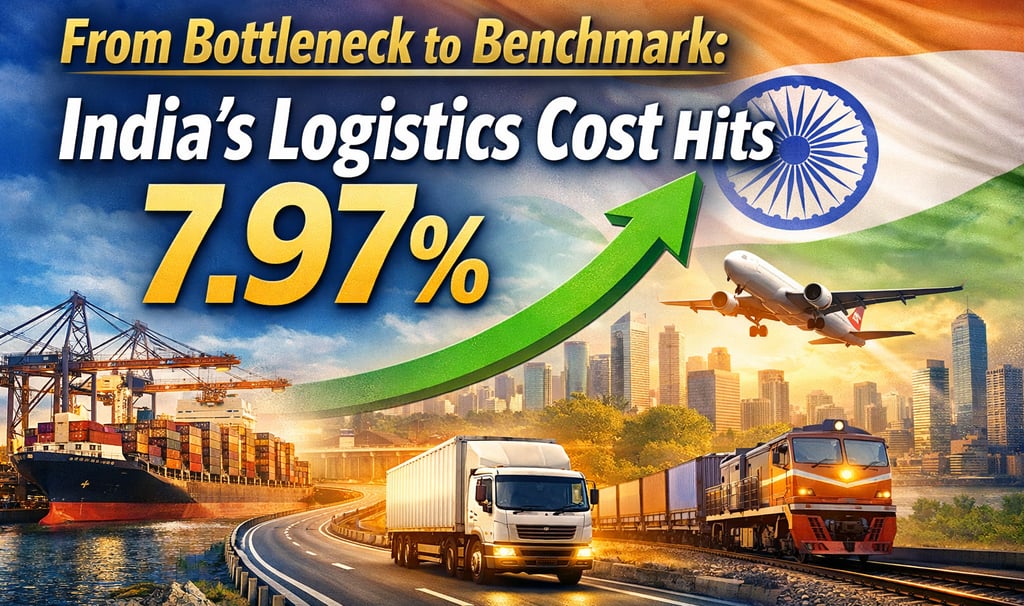
India has officially joined the league of advanced economies with a reassessed logistics cost of just 7.97% of GDP, marking a historic transformation in the country’s logistics and supply chain ecosystem. This achievement signals a paradigm shift from inefficiency-driven logistics to a technology-enabled, policy-backed, and infrastructure-driven logistics economy.
Earlier estimates placed India’s logistics cost between 13–14% of GDP, significantly higher than global benchmarks. The revised figure reflects structural reforms, digital integration, multimodal transport development, and private sector efficiency, positioning India as a globally competitive manufacturing and export hub.
📦 What Is Logistics Cost and Why It Matters?
Logistics cost includes:
Transportation (road, rail, air, waterways)
Warehousing & storage
Inventory holding
Packaging & handling
Administrative and compliance costs
A lower logistics cost directly translates into:
Cheaper goods for consumers
Higher profit margins for MSMEs
Better global competitiveness for exports
Faster supply chain movement
With 7.97% logistics cost to GDP, India is now comparable to developed economies, a feat once considered unattainable for a large and diverse country.
🚀 Key Reasons Behind India’s Logistics Cost Reduction
1. PM Gati Shakti National Master Plan
The integrated planning framework has synchronized roads, railways, ports, airports, and logistics parks, reducing duplication and delays.
Impact:
✔ Faster project execution
✔ Seamless multimodal connectivity
✔ Reduced last-mile inefficiencies
2. Massive Infrastructure Expansion
India has invested heavily in:
Expressways & Bharatmala highways
Dedicated Freight Corridors (DFCs)
Port modernization under Sagarmala
Inland waterways development
Result:
Lower fuel consumption, reduced transit time, and improved asset utilization.
3. Digital Transformation in Logistics
Technology adoption has played a critical role:
E-way bills & FASTag
GPS-based fleet tracking
AI-driven route optimization
Digital tolling & automated checkpoints
Outcome:
✔ Reduced idle time
✔ Less paperwork
✔ Predictable delivery timelines
4. GST – The Game Changer
The implementation of Goods and Services Tax (GST) removed inter-state barriers and multiple checkpoints.
Before GST:
Trucks wasted hours at state borders
Fragmented warehousing
After GST:
Hub-and-spoke warehousing models
Faster interstate movement
This alone contributed significantly to logistics cost reduction.
5. Rise of Organized Warehousing
India has seen rapid growth in:
Grade-A warehouses
Cold chain infrastructure
Automated fulfillment centers
Benefits:
Reduced inventory holding cost
Lower damage and wastage
Faster order fulfillment
🌍 India vs Global Logistics Benchmarks
CountryLogistics Cost (% of GDP)Germany~8%USA~8–9%Japan~7.5%India (Reassessed)7.97%
This comparison clearly shows that India is no longer a high-cost logistics economy.
🏭 Impact on MSMEs, Transporters & Logistics Companies
✅ MSMEs
Lower freight cost
Improved access to national markets
Higher export competitiveness
🚛 Transporters
Better road quality = lower maintenance
Faster turnaround time
Higher vehicle productivity
🏗 Logistics & Warehousing Firms
Higher demand for integrated logistics
Growth in 3PL & 4PL services
Expansion into Tier-2 & Tier-3 cities
📈 Boost to Manufacturing & Exports
Lower logistics costs directly support:
Make in India
Atmanirbhar Bharat
PLI schemes
Sectors like:
Automobiles
Pharmaceuticals
FMCG
Electronics
Agriculture & food processing
will gain global price competitiveness, accelerating India’s export growth.
🔮 What This Means for India’s Future
With logistics cost nearing global best standards, India is set to:
Become a global supply chain alternative
Attract foreign direct investment (FDI)
Strengthen its position as a manufacturing powerhouse
Create millions of logistics and transport jobs
The focus now shifts from cost reduction to value creation, sustainability, and green logistics.
♻️ Towards Green & Smart Logistics
Next phase priorities include:
Electric trucks & LNG vehicles
Rail & waterways shift
Carbon-neutral warehouses
AI-powered logistics planning
These initiatives will ensure long-term sustainability without compromising efficiency.
📝 Conclusion
India’s reassessed logistics cost of 7.97% of GDP is more than just a statistic—it is a validation of a decade-long reform journey. From highways and ports to digital systems and policy alignment, India has successfully transformed one of its biggest structural weaknesses into a competitive strength.
As logistics becomes faster, cheaper, and smarter, India is well on track to emerge as a global logistics and manufacturing leader in the coming decade.
India logistics cost to GDP, logistics cost India 7.97%, Indian logistics sector growth, supply chain efficiency India, PM Gati Shakti logistics, GST impact on logistics, India transport infrastructure, logistics industry India, freight cost reduction India, warehousing growth India