India–EU Free Trade Agreement 2026: How European Cars Will Transform India’s Auto Market
While domestic giants will continue dominating the mass-market segment, European brands are set to strengthen their presence in the premium and luxury category. The deal not only reshapes pricing structures but also enhances India’s position as a global automotive and logistics hub.
EDUCATION
2/16/20264 min read
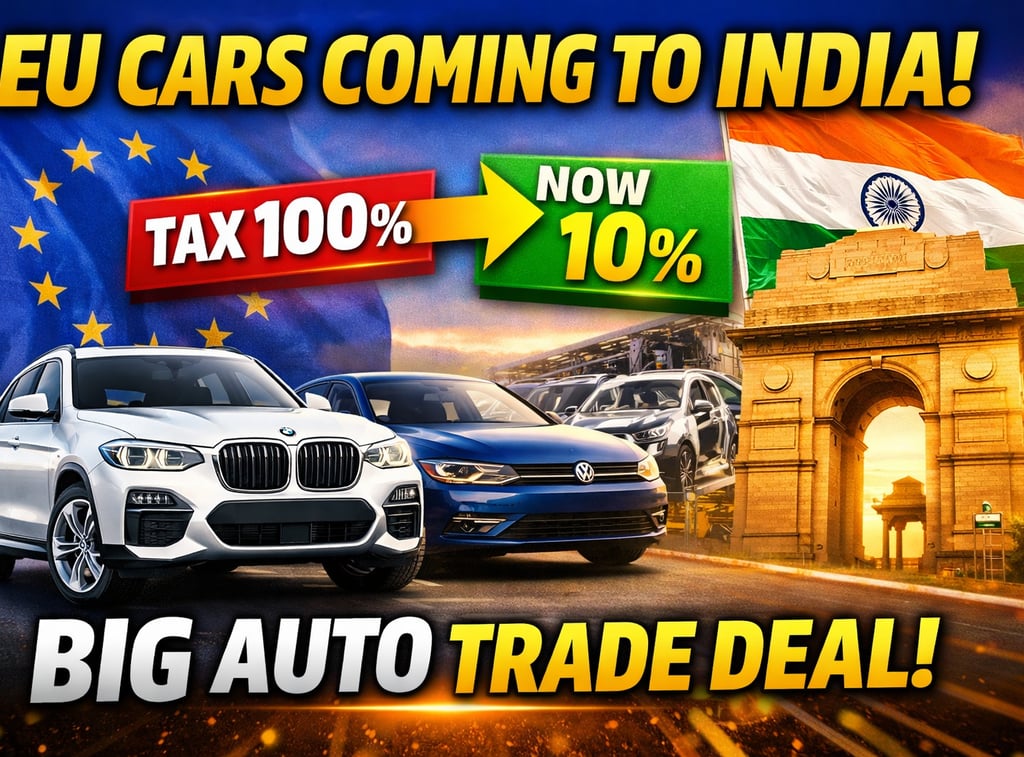
The India–EU Free Trade Agreement (FTA) 2026 is set to reshape the future of the Indian automobile industry. With import duties on European commercial and passenger vehicles expected to fall from 70–110% to just 10% over five years, the agreement opens new doors for global automotive giants. For European brands such as Volkswagen, Renault, and Stellantis, this deal represents a historic opportunity to expand in the world’s third-largest automobile market — India.
At the same time, the Indian market remains highly competitive, dominated by strong domestic players like Maruti Suzuki and Tata Motors. So, what does this trade agreement really mean for pricing, competition, electric vehicles, and logistics? Let’s explore in detail.
Key Highlights of the India–EU Trade Agreement
1. Major Reduction in Import Duties
Under the FTA framework:
Import tariffs on European vehicles will reduce gradually to 10% within five years.
Earlier, fully built imported cars (CBUs) faced 70% to 110% duties, making European cars extremely expensive.
The tariff reduction applies to a quota of 250,000 vehicles annually.
This move will significantly improve the competitiveness of European luxury and premium vehicles in India.
2. Import Quota: 250,000 Vehicles Per Year
The agreement allows up to 250,000 European vehicles annually under reduced tariffs. This quota ensures:
Controlled market entry.
Protection for domestic manufacturers.
Focus on premium and high-end segments rather than mass-market cars.
This quota system benefits established European luxury brands such as Mercedes-Benz, BMW, Audi, and Volvo Cars, which already operate in India.
3. CKD (Completely Knocked Down) Advantage
One of the most impactful provisions is the CKD scheme:
75,000 vehicles annually can be exported as Completely Knocked Down (CKD) kits.
Import duty on CKD vehicles will reduce to 8.25%.
Duties on automotive parts will be eliminated.
This will encourage European manufacturers to assemble vehicles locally in India, reducing costs while boosting employment and supply chain activity.
Brands like Volkswagen and Skoda already use Indian assembly plants, and the new policy will likely expand such operations.
4. Electric Vehicles (EV) Protection Clause
India has protected its domestic EV industry under this deal:
Duty reductions on European electric vehicles will begin after 10 years.
This delay protects domestic EV manufacturers and supports the government’s “Make in India” initiative.
India’s EV market is rapidly growing, with companies like Tata Motors leading the charge domestically.
Market Impact: Who Benefits the Most?
Premium Segment Will See Growth
European brands are unlikely to compete directly in India’s budget car segment, which is dominated by Maruti Suzuki and Tata Motors. Instead, they will:
Focus on luxury SUVs.
Expand premium sedan offerings.
Introduce high-end electric vehicles over time.
The agreement strengthens India’s premium automobile segment, offering consumers more choices at competitive prices.
Will European Car Prices Drop Immediately?
Although tariffs are being reduced, experts suggest that prices may not fall drastically in the short term. Why?
Local production costs remain high.
Assembly investments require time.
Limited quota restricts supply.
Currency fluctuations impact pricing.
Logistics and compliance costs add expenses.
However, over time, increased competition and higher localization levels may gradually reduce vehicle prices.
Impact on India’s Automotive Logistics Industry
The India–EU FTA will also boost the automotive logistics and transport sector:
Increased import of CKD kits.
Growth in port handling activities.
Expansion in warehousing and distribution.
More demand for vehicle carriers and container logistics.
India’s growing infrastructure and improved port connectivity will support faster integration with European supply chains.
For logistics operators and transport businesses, this agreement creates fresh opportunities in automotive freight movement.
Strategic Importance for India
India is now the third-largest automobile market globally, after China and the United States. This FTA signals:
Stronger trade ties between India and Europe.
Increased foreign investment in manufacturing.
Technology transfer and innovation sharing.
Improved competitiveness of Indian auto suppliers.
European automakers gain access to a massive consumer base, while India gains technology, jobs, and industrial development.
Challenges European Brands May Face
Despite tariff reductions, European manufacturers must navigate:
Strong price sensitivity in India.
Established dealer networks of domestic brands.
Service and maintenance cost expectations.
Localization requirements.
Policy and regulatory compliance.
The Indian consumer market demands value-for-money vehicles, which means European brands must carefully balance pricing, features, and brand positioning.
Opportunities for Commercial Vehicles
The agreement also supports European commercial vehicle manufacturers. This could:
Increase availability of advanced truck technologies.
Introduce fuel-efficient and safety-enhanced transport vehicles.
Strengthen India’s freight and logistics infrastructure.
Commercial vehicle partnerships may boost efficiency in the Indian transport sector.
Long-Term Outlook (2026–2035)
Over the next decade, the India–EU FTA is expected to:
Expand premium car penetration.
Encourage joint ventures.
Increase local manufacturing investments.
Strengthen India’s role as a global automotive hub.
Promote technology sharing in EV and hybrid segments.
The delayed EV tariff reduction ensures India develops its domestic electric vehicle ecosystem before facing full European competition.
India EU Free Trade Agreement 2026
European cars in India
Reduced import duty on cars
India automobile market 2026
Premium car market India
CKD vehicle import India
India auto industry growth
European electric vehicles in India
Automobile logistics industry India
India EU trade impact on auto sector
Conclusion
The India–EU Free Trade Agreement 2026 represents a transformative milestone for the Indian automobile sector. By reducing import tariffs to 10% and enabling CKD assembly with just 8.25% duty, the agreement opens a structured pathway for European car manufacturers to expand in India.
While domestic giants will continue dominating the mass-market segment, European brands are set to strengthen their presence in the premium and luxury category. The deal not only reshapes pricing structures but also enhances India’s position as a global automotive and logistics hub.
For consumers, manufacturers, and logistics operators alike, this agreement marks the beginning of a new era in India’s automotive journey.