India Logistics Industry 2026: AI Revolution, Infrastructure Boom & Green Freight Driving Record Growth
With logistics costs now reduced to 7.97% of GDP, strong government policy support, and major expansions by global and domestic players, India is emerging as a major logistics hub in Asia.
NEWS
2/13/20263 min read
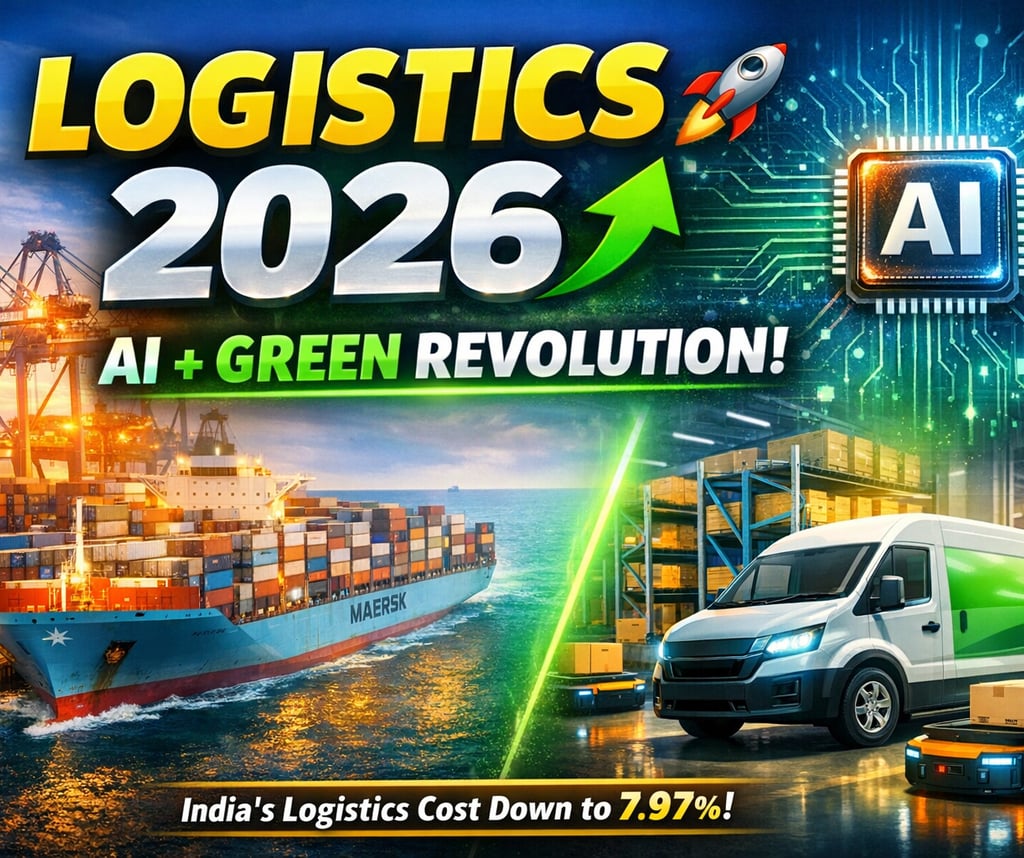
The logistics industry in early 2026 is witnessing one of its most transformative phases in history. From record-breaking infrastructure investments to AI-driven digital platforms and sustainable freight solutions, India’s logistics sector is rapidly evolving into a globally competitive ecosystem.
With logistics costs now reduced to 7.97% of GDP, strong government policy support, and major expansions by global and domestic players, India is emerging as a major logistics hub in Asia.
Let’s explore the latest logistics industry trends in 2026, major company expansions, AI integration, air cargo updates, and sustainable freight developments shaping the future.
Infrastructure & Policy: India’s Logistics Cost Falls to 7.97% of GDP
India has made remarkable progress in improving logistics efficiency. The reduction of logistics cost to 7.97% of GDP reflects improvements in multimodal transport, digital tracking, and supply chain integration.
The 2026 Union Budget emphasizes:
Reducing supply chain inefficiencies
Minimizing food wastage caused by poor storage
Expanding cold chain infrastructure
Improving rail-road-port connectivity
Government-backed initiatives like PM Gati Shakti and National Logistics Policy continue to streamline freight movement across highways, railways, inland waterways, and ports.
This infrastructure push is helping:
Lower transportation costs
Improve delivery timelines
Boost export competitiveness
Attract foreign direct investment (FDI) in logistics
Company Expansion & Financial Performance in Q3 2026
Several major logistics companies have reported strong quarterly performance, signaling robust sectoral growth.
🚢 Adani Ports and Special Economic Zone
4
Adani Ports reported a 21% surge in Q3 profit, reaching ₹3,043 crore. Growth was driven by:
Higher cargo volumes
Improved operational efficiency
Strong container traffic
Expansion in international port operations
Adani’s aggressive port-led logistics expansion strategy is strengthening India’s maritime infrastructure.
📦 Allcargo Terminals
Allcargo Terminals posted a 28% rise in Q3 profit, benefiting from increased container handling and terminal automation upgrades.
Their growth reflects:
Rising EXIM trade
Demand for faster turnaround times
Digitally optimized yard management systems
🏗️ TVS Industrial & Logistics Parks (TVS ILP)
TVS ILP is developing a ₹250 crore logistics park in Indore, strengthening warehousing capacity in central India. The project supports:
E-commerce fulfillment
FMCG distribution
Automotive supply chains
This aligns with the increasing demand for Grade-A warehouses across tier-2 cities.
Global Warehouse Expansion: DHL & Kuehne+Nagel
International logistics giants are expanding aggressively in India.
🌍 DHL
4
DHL is expanding its warehouse footprint to support:
E-commerce growth
Pharmaceutical logistics
Temperature-controlled storage
🚛 Kuehne+Nagel
4
Kuehne+Nagel is focusing on:
Digital freight forwarding
Green shipping solutions
AI-driven inventory visibility
Their expansion reflects confidence in India’s rising freight demand.
AI & Digital Transformation: The Smart Logistics Era
Artificial Intelligence is redefining supply chains in 2026.
🚀 Freightfynd & AI Platforms
AI integration is optimizing:
Route planning
Fuel efficiency
Predictive maintenance
Real-time shipment tracking
Startups like Freightfynd are enabling digital freight aggregation platforms, helping small fleet owners access national markets.
💻 Velocity & CargoTech Investments
Velocity is investing ₹100 crore in an AI-led shipping platform.
CargoTech plans to launch nine AI-driven products in 2026.
These platforms focus on:
Demand forecasting
Automated documentation
Blockchain-enabled tracking
AI-based risk assessment
The result: Faster, more transparent, and cost-efficient logistics operations.
Cybersecurity Threats in Logistics
With increased digitization comes rising cybersecurity risks.
Major concerns include:
Ransomware attacks on ports
Data breaches in freight systems
AI manipulation risks
Supply chain disruption
Logistics companies are now investing heavily in:
Cloud security
Multi-layered authentication
Real-time threat detection
Cyber resilience has become a top priority in 2026.
Air Cargo & Shipping Industry Updates
✈️ Jet Airways
4
Jet Airways sold three Boeing 777 aircraft to the Challenge Group. This indicates strategic restructuring and shifting focus in air cargo operations.
🚢 Maersk
4
Maersk added eight large vessels to its order book, signaling confidence in long-term global trade recovery and container shipping demand.
The shipping industry in 2026 is adapting to:
Red Sea route disruptions
Rising fuel prices
Decarbonization regulations
Green & Sustainable Logistics: The Future of Freight
Environmental sustainability is no longer optional.
🌱 Blue Dart Express
4
Blue Dart launched a green integrated ground hub in Pataudi, reinforcing its commitment to:
Solar-powered facilities
Electric delivery vehicles
Carbon footprint reduction
Green logistics trends in 2026 include:
EV-based last-mile delivery
LNG-powered trucks
Sustainable packaging
Carbon credit programs
Companies focusing on ESG (Environmental, Social, Governance) are attracting more investors.
E-Commerce & Emerging Market Trends
🛒 Flipkart
Flipkart is exploring entry into the online food delivery segment. This move could significantly impact:
Cold chain logistics
Hyperlocal delivery networks
Quick commerce infrastructure
With India’s e-commerce market booming, logistics companies must scale rapidly to support:
Same-day delivery
10-minute grocery models
Regional warehousing hubs
Key Logistics Industry Trends in 2026
AI-powered supply chains
Expansion of Grade-A warehouses
Reduced logistics costs in India
Green freight and EV adoption
Cybersecurity investments
Multimodal transportation growth
Air cargo restructuring
Port modernization
E-commerce-driven logistics demand
Infrastructure-led cost optimization
Conclusion: India’s Logistics Sector at a Turning Point
The Indian logistics industry in 2026 stands at a critical transformation stage. With government reforms, record infrastructure growth, AI integration, and sustainability commitments, the sector is becoming faster, smarter, and greener.
Major players like Adani Ports, DHL, Kuehne+Nagel, Maersk, and Blue Dart are expanding aggressively, while startups are reshaping digital freight systems.
For investors, fleet owners, warehouse developers, and supply chain professionals, 2026 presents enormous opportunities in:
AI logistics platforms
Green warehousing
Cold chain expansion
Port infrastructure
E-commerce fulfillment
India is no longer just a logistics market — it is becoming a global logistics powerhouse.
FAQs – Logistics Industry 2026
Q1: What is India’s logistics cost in 2026?
India’s logistics cost has reduced to 7.97% of GDP.
Q2: What are the top logistics trends in 2026?
AI integration, green freight, warehouse expansion, cybersecurity focus, and infrastructure modernization.
Q3: Which companies are expanding in India’s logistics sector?
Adani Ports, DHL, Kuehne+Nagel, TVS ILP, Blue Dart, and Maersk are key players expanding operations.
Q4: How is AI transforming logistics?
AI enables predictive analytics, route optimization, real-time tracking, automated documentation, and risk management.
Q5: Why is green logistics important?
It reduces carbon emissions, improves ESG ratings, lowers fuel costs, and supports sustainable economic growth.