“India’s Trucking Revolution: Green Fuels, Rising Sales, and Safer Highways Drive the Next Era of Freight Mobility”
To improve safety, the government has announced that emergency braking systems and driver drowsiness alerts will soon become mandatory in all large passenger and heavy-duty vehicles. These technologies are expected to reduce highway accidents and enhance driver welfare, complementing ongoing efforts to modernize India’s freight mobility infrastructure.
11/10/20252 min read
November 2025 – New Delhi: India’s commercial vehicle (CV) and trucking sector is witnessing a dynamic phase of change, marked by strong market growth, rising sustainability efforts, and tougher enforcement on road safety. The government’s latest push toward hydrogen-powered and electric trucks, alongside a 17.70% jump in CV sales in October 2025, underscores the sector’s resilience and transition toward cleaner freight mobility.
Government Initiatives and Technology Drive
In a major move toward decarbonizing road transport, the Government of India has launched an incentive scheme specifically for hydrogen and electric trucks. This comes as part of a broader mission to promote zero-emission freight vehicles under the National Green Mobility initiative. The policy aims to reduce logistics-related emissions by offering fiscal benefits and subsidies for early adopters of hydrogen fuel cell and battery-electric heavy vehicles.
Hydrogen fuel cell pilot projects are already underway, involving leading OEMs and research institutions. These initiatives will pave the way for large-scale deployment of fuel cell-powered trucks on intercity and industrial routes by the end of the decade.
In parallel, the EV ecosystem is expanding. Exponent Energy’s rapid charging technology, initially developed for three-wheelers, is being viewed as a model for future electric trucks. Its ultra-fast charging capabilities—replenishing batteries within 15 minutes—could revolutionize long-haul electric freight operations if scaled up.
Another interesting development involves the possible reintroduction of long-nose truck designs in India. The government is holding consultations with manufacturers to explore this change, as long-nose cabs can significantly enhance driver visibility and crash safety compared to traditional flat-nose cabs.
Market Performance and Industry Trends
The Indian commercial vehicle market continues to grow steadily, with CV sales rising 17.70% in October 2025 compared to the previous year. Growth was particularly strong in the light and medium commercial vehicle (LCV and MCV) segments, supported by rural demand, infrastructure projects, and e-commerce logistics.
At the same time, the used truck market is booming. Rising diesel prices and the high cost of new vehicles have pushed fleet owners and small transporters toward pre-owned options. Dealers report that used truck demand has increased sharply in Tier-2 and Tier-3 cities, where operational costs and financing options play a crucial role in purchase decisions.
Tata Motors continues to strengthen its profitability strategy by focusing on the pickup segment. By cutting down on retail discounts, the company has improved per-unit realizations and expanded market share in recent quarters. Ashok Leyland has also made headlines with a strategic order to supply 200 trucks to Instant Transport Solution, boosting its medium and heavy commercial vehicle presence.
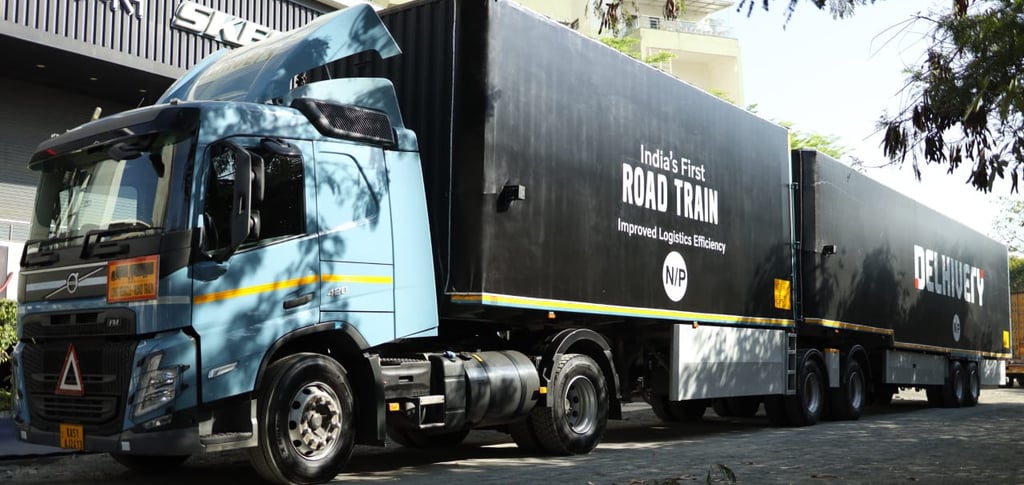
On the premium end, Volvo Trucks India has delivered 20 LNG-powered trucks to Delhivery, marking a milestone in alternative fuel adoption. The brand also unveiled upgraded heavy-duty models featuring advanced driver-assistance systems, improved fuel efficiency, and digital connectivity for fleet optimization.
Regulations and Challenges
Despite progress, the trucking sector continues to face challenges—especially overloading, which remains rampant across highways. Recent enforcement drives have led to a 28% surge in overloading offenses, prompting authorities to tighten penalties and deploy more weigh-in-motion sensors.
To improve safety, the government has announced that emergency braking systems and driver drowsiness alerts will soon become mandatory in all large passenger and heavy-duty vehicles. These technologies are expected to reduce highway accidents and enhance driver welfare, complementing ongoing efforts to modernize India’s freight mobility infrastructure.