Mapping the Trajectory of Project Logistics in India: Growth, Challenges, and Future Outlook
This article provides a 1000-word, SEO-friendly deep dive into the trajectory of project logistics in India, covering market drivers, challenges, technology adoption, government initiatives, and future opportunities—along with a detailed FAQ section to help businesses, logistics professionals, and investors.
1/19/20264 min read
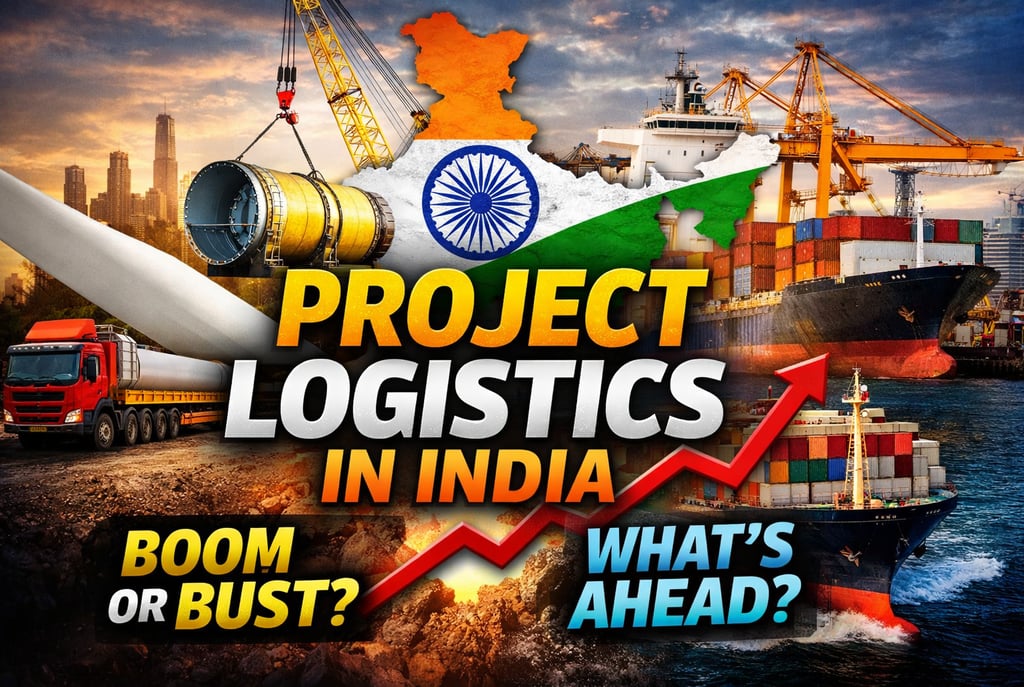
Project logistics in India is emerging as one of the most critical pillars supporting the nation’s infrastructure, energy, and industrial ambitions. As India accelerates investments in highways, railways, ports, renewable energy, oil & gas, mining, steel, cement, and power projects, the demand for specialized project logistics services has grown exponentially. Handling oversized, heavy, and high-value cargo requires expert planning, engineering precision, regulatory coordination, and seamless multimodal execution.
This article provides a 1000-word, SEO-friendly deep dive into the trajectory of project logistics in India, covering market drivers, challenges, technology adoption, government initiatives, and future opportunities—along with a detailed FAQ section to help businesses, logistics professionals, and investors.
What Is Project Logistics?
Project logistics refers to the end-to-end planning, execution, and control of complex cargo movements for large industrial and infrastructure projects. This includes:
Over-Dimensional Cargo (ODC)
Heavy lift equipment
Power plant machinery
Wind turbine blades and towers
Refinery and petrochemical modules
Mining and construction equipment
Unlike conventional freight, project logistics demands route surveys, load calculations, special permits, escorts, custom equipment, and multimodal coordination involving road, rail, coastal shipping, and inland waterways.
Why Project Logistics Is Growing Rapidly in India
1. Infrastructure Boom
India is witnessing one of the world’s largest infrastructure expansions. Mega investments in highways, expressways, metro rail, ports, airports, and industrial corridors have created massive demand for project cargo logistics services.
2. Manufacturing & Industrial Expansion
Government initiatives such as Make in India and Atmanirbhar Bharat are pushing domestic manufacturing of heavy machinery, steel structures, and industrial equipment—fueling domestic project cargo movement.
3. Renewable Energy Projects
India’s renewable energy targets have accelerated wind and solar projects. Wind turbine logistics alone involves transporting blades exceeding 70 meters and nacelles weighing over 100 tonnes—making heavy haulage logistics indispensable.
4. PM Gati Shakti National Master Plan
The PM Gati Shakti National Master Plan integrates roads, railways, ports, and logistics parks into a single digital platform, significantly improving planning efficiency for project logistics operators.
Key Challenges in Project Logistics in India
Infrastructure Constraints
Despite progress, many Indian roads, bridges, and rail routes are still not designed for oversized or ultra-heavy cargo. Low bridge clearances, sharp curves, and weak pavements increase transit risk and cost.
Regulatory & Permit Complexity
ODC movement requires multiple permissions from:
State transport authorities
Police departments
Highway authorities
Port and municipal bodies
Since rules vary across states, permit delays remain a major bottleneck.
Multimodal Coordination Issues
Project cargo often changes transport modes multiple times. Poor coordination between ports, railways, road transporters, and customs can lead to demurrage, storage costs, and project delays.
Skilled Manpower Shortage
Project logistics demands experienced engineers, surveyors, and operators. The industry faces a shortage of skilled professionals trained in heavy lift planning and execution.
Role of Technology in Modern Project Logistics
Digital Planning & Simulation
Advanced route simulation software helps logistics providers:
Identify bottlenecks
Calculate axle loads
Plan safe turning radii
Reduce trial-and-error execution
Real-Time Tracking & Visibility
GPS, IoT sensors, and digital dashboards enable real-time cargo tracking, improving safety, accountability, and customer confidence.
Data-Driven Decision Making
Analytics helps optimize routes, reduce idle time, and control fuel consumption—leading to cost-efficient project logistics operations.
Sustainability and Green Project Logistics
Sustainability is becoming a key differentiator in Indian project logistics:
Use of bio-CNG and alternative fuels
Route optimization to reduce emissions
Coastal shipping and inland waterways to cut carbon footprint
Reusable packing and modular transport designs
Green logistics is no longer optional—it is increasingly demanded by global EPC companies and investors.
Future Outlook of Project Logistics in India
The future of project logistics in India looks strong and resilient:
Continued infrastructure investment ensures long-term demand
Multimodal logistics parks will reduce costs and transit time
Policy reforms may simplify ODC permits nationwide
Automation and AI-driven planning will enhance safety and efficiency
As India positions itself as a global manufacturing and infrastructure hub, project logistics will play a strategic role in economic growth.
SEO Keywords Used (Naturally Integrated)
Project logistics India, heavy lift logistics India, ODC transport India, infrastructure logistics India, multimodal logistics India, project cargo services, oversized cargo transport, renewable energy logistics India, PM Gati Shakti logistics, industrial project logistics.
Frequently Asked Questions (FAQ)
1. What is project logistics in simple terms?
Project logistics is the specialized transportation and management of oversized, heavy, and complex cargo required for large infrastructure and industrial projects.
2. Why is project logistics important for India?
India’s infrastructure growth depends on safe and timely movement of heavy machinery and equipment. Without project logistics, mega projects would face severe delays.
3. What industries use project logistics the most?
Key industries include power, renewable energy, oil & gas, mining, steel, cement, construction, and heavy engineering.
4. What is ODC cargo?
ODC (Over-Dimensional Cargo) refers to cargo that exceeds standard vehicle dimensions or weight limits and requires special permits and handling.
5. What transport modes are used in project logistics?
Road, rail, coastal shipping, inland waterways, and sometimes air (for high-value urgent cargo).
6. What are the main challenges in India?
Infrastructure limitations, permit delays, regulatory complexity, and lack of skilled manpower.
7. How does PM Gati Shakti help project logistics?
It integrates infrastructure planning across ministries, improving route planning, reducing bottlenecks, and enabling faster cargo movement.
8. Is project logistics profitable?
Yes, but it is capital-intensive and risk-sensitive. Profitability depends on expertise, planning accuracy, and execution quality.
9. How is technology changing project logistics?
Technology improves route planning, tracking, safety, and cost control through digital tools, GPS, IoT, and analytics.
10. What is the future of project logistics in India?
With continued infrastructure and industrial growth, project logistics will remain a high-growth, strategic sector for decades.
Final Thoughts
Project logistics is no longer a niche segment—it is a strategic backbone of India’s development journey. Companies that invest in technology, skilled manpower, multimodal capabilities, and sustainability will lead the next phase of growth in India’s project logistics ecosystem.