RTO Official in Bengaluru Suspended for Issuing Fitness Certificates to Gujarat Vehicles Without Inspection
As India modernizes its transport administration, this incident stands as a reminder that technology must be backed by integrity, and any compromise on road safety will invite strict action—regardless of rank or position.
1/24/20263 min read

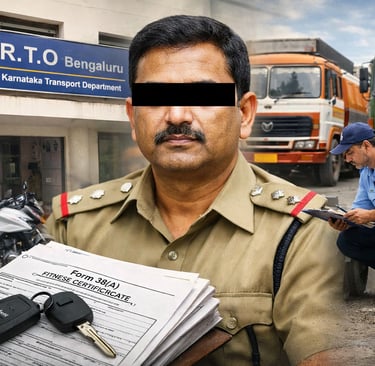
In a major crackdown on alleged corruption and procedural violations, the Karnataka Transport Department has suspended a senior Regional Transport Office (RTO) official in Bengaluru for issuing Fitness Certificates (FCs) to 41 heavy motor vehicles registered in Gujarat without conducting mandatory physical inspections. The incident has raised serious concerns about the misuse of digital transport systems and inter-state regulatory compliance under India’s Motor Vehicles framework.
The suspension follows a detailed data-driven investigation triggered by authorities in Gujarat, highlighting the increasing role of technology such as VAHAN 4.0 and e-detection portals in exposing irregularities within government departments.
Senior RTO Official Suspended in Bengaluru
The official placed under suspension is Nisar Ahmed, a Senior Motor Vehicle Inspector posted at the Koramangala Regional Transport Office. Acting on the directions of Ramalinga Reddy, the Commissioner of the Karnataka Transport Department issued the suspension order on January 20 for alleged dereliction of duty.
According to officials, Mr. Ahmed approved Form-38(A) Fitness Certificates for 41 transport vehicles without verifying their physical presence—an act that constitutes a clear violation of statutory norms under the Motor Vehicles Act.
How the Irregularity Was Detected
The irregularity came to light due to the proactive efforts of the Gujarat State Transport Department. Its e-Detection team analyzed vehicle movement and inspection data available on the centralized VAHAN 4.0 software platform.
The findings were alarming:
All 41 heavy motor vehicles were registered in Gujarat
The system showed that these vehicles were “inspected” at RTOs in Karnataka
On the same dates, toll plaza records confirmed that the vehicles were physically present in Gujarat
This made any inspection in Karnataka logically and physically impossible.
Alert from Gujarat Transport Commissioner’s Office
The matter was officially escalated by the Office of the Transport Commissioner, Gandhinagar. The Deputy Director informed Karnataka authorities that all FC approvals had been digitally authorized by Mr. Ahmed from Bengaluru.
Following this alert, Karnataka initiated an internal probe to verify the authenticity of the approvals and cross-check the data.
Probe Confirms Serious Violations
The investigation relied heavily on VAHAN 4.0, India’s national vehicle database, which integrates registration, fitness, permits, and inspection details across states.
Officials confirmed that:
Mr. Ahmed had digitally renewed FCs for all 41 vehicles
Mandatory physical inspection norms were bypassed
Vehicles were never present in Karnataka during inspection dates
A senior official stated that the evidence conclusively proved manipulation or misuse of official access, leading to a violation of both the Motor Vehicles Act and associated transport rules.
What Is a Fitness Certificate and Why It Matters
A Fitness Certificate (FC) is a mandatory document for transport vehicles in India, certifying that a vehicle is roadworthy and complies with safety and emission standards.
Key facts about Fitness Certificates:
Issued using Form-38(A)
Mandatory for commercial and heavy motor vehicles
Requires physical inspection by an authorized Motor Vehicle Inspector
Ensures road safety, environmental compliance, and accident prevention
Issuing FCs without inspection can allow unsafe vehicles on roads, increasing risks to public safety.
Role of Digital Systems: Boon or Vulnerability?
While platforms like VAHAN 4.0 and e-Detection portals are designed to improve transparency, this case highlights how digital systems can also be misused if proper checks and accountability mechanisms are not enforced.
However, the same digital footprint ultimately helped uncover the scam—showing that data analytics and inter-state coordination are powerful tools against corruption.
Government Response and Zero-Tolerance Stand
Transport Minister Ramalinga Reddy ordered an immediate probe upon receiving preliminary findings. Officials say the government is adopting a zero-tolerance policy toward violations that compromise public safety and institutional integrity.
Sources indicate that further disciplinary action, including departmental inquiry and possible criminal proceedings, may follow depending on the final probe report.
Implications for Transporters and Vehicle Owners
This case serves as a strong warning to:
Transporters seeking shortcuts for FC renewals
Agents and middlemen facilitating illegal approvals
Officials misusing digital access
Authorities have reiterated that inter-state vehicle inspections must strictly follow physical verification norms, regardless of digital convenience.
Strengthening Inter-State Transport Oversight
The collaboration between Karnataka and Gujarat transport authorities demonstrates a growing emphasis on cooperative federalism in governance. With real-time data sharing and toll integration, similar frauds are likely to be detected faster in the future.
Experts suggest:
Random audit of FC approvals
Geo-location tagging during inspections
Stronger login accountability for RTO officials
Conclusion
The suspension of a senior RTO official in Bengaluru for issuing Fitness Certificates to Gujarat vehicles without inspection underscores the importance of rule-based governance, data transparency, and official accountability. While digital platforms like VAHAN 4.0 can be exploited, they also act as powerful watchdogs when used effectively.
As India modernizes its transport administration, this incident stands as a reminder that technology must be backed by integrity, and any compromise on road safety will invite strict action—regardless of rank or position.